How to Make Obsidian in Minecraft
How to make obsidian in Minecraft: pour water onto a lava source block, then mine it with a diamond or netherite pickaxe. Methods, mining times and tips.

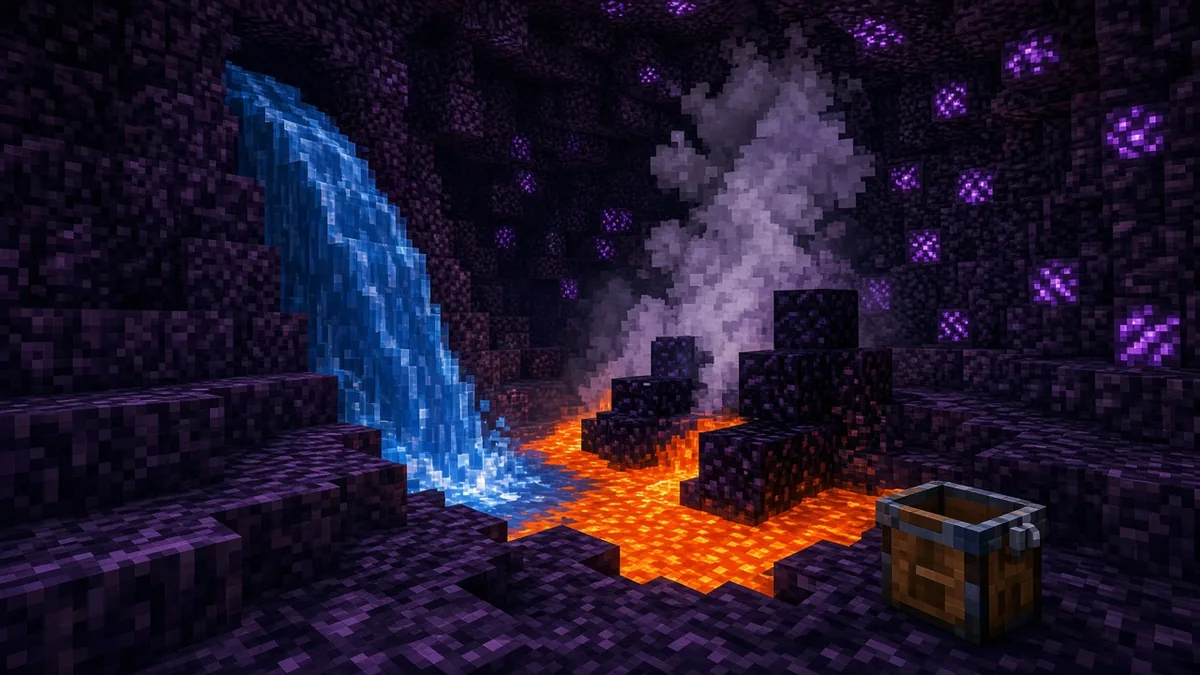
To make obsidian in Minecraft, let water flow onto a lava source block: the source instantly hardens into one block of obsidian. To pick it up, mine it with a diamond or netherite pickaxe, which takes about 9.4 or 8.35 seconds per block unenchanted, per the Minecraft Wiki. Anything weaker breaks it and drops nothing. Only need a Nether portal? You can cast the frame in place and skip mining entirely. This works the same in Java 26.3 and Bedrock 26.60 (November 2026).
Key takeaways
What you need to make obsidian
Obsidian has no crafting recipe. You make it with two fluids and collect it with the right pickaxe, so pack these before heading to a lava pool.
- A water bucket: craft a bucket from 3 iron ingots and fill it at any water source.
- Lava source blocks: a lava pool, or a lava bucket you pour out wherever you like.
- A diamond or netherite pickaxe: only if you want to carry the obsidian away.
- Spare blocks: dirt or cobblestone to wall off lava and plug holes.
- Optional: a Potion of Fire Resistance, which turns a lava mistake into a minor annoyance.
How to make obsidian in Minecraft, step by step
Everything hinges on one rule: the water must reach a lava source block. Here’s what the reaction looks like, followed by the steps.
- Find still lava. Surface lava pools, deep caves and lava lakes all work. The flat, full-height blocks in a pool are sources. The sloped blocks running downhill are flowing lava.
- Test a block if you’re unsure. Use an empty bucket on it. If the bucket fills, it’s a source. If not, it’s flowing.
- Wall off one side. Put a block next to the pool so water can’t push you in, and stand on solid ground.
- Pour the water. Place it on the block beside the pool, one level up, so it runs across the lava’s surface. Each source it touches turns to obsidian.
- Scoop the water back. Use the empty bucket on the block where you poured it so the flow stops.
- Mine with a diamond or netherite pickaxe. Before you break a block, check what’s under it. Pools are often more than one block deep.
Prefer zero risk? Dig a one-block hole, pour a lava bucket into it, then pour water next to it. You get one clean block of obsidian at a time, with nothing to fall into.
Why did I get cobblestone or stone instead?
Because the water hit the wrong kind of lava. When water reaches flowing lava from the side, that spot becomes cobblestone. When lava flows down onto water, you get stone. Only a lava source block converts to obsidian. If your pool keeps giving you cobblestone, you’re pouring at the edge where lava is spilling out, not onto the pool itself. Move closer to the middle, or test with an empty bucket first. The same rule explains the cobblestone pillars you see around lava lakes in caves: that’s water meeting lava that was still flowing.
How long does it take to mine obsidian?
Obsidian has a hardness of 50 in Java (35 in Bedrock, with the same break times), the slowest of any block you’ll regularly mine. These are the Minecraft Wiki’s breaking times for unenchanted tools with no status effects.
| Tool | Time per block | Drops obsidian? |
|---|---|---|
| Hand | 250 s | No |
| Copper pickaxe | 50 s | No |
| Iron pickaxe | 41.7 s | No |
| Golden pickaxe | 20.85 s | No |
| Diamond pickaxe | 9.4 s | Yes |
| Netherite pickaxe | 8.35 s | Yes |
Efficiency enchantments and the Haste effect from a beacon cut those times a lot. Mining while swimming or while your feet are off the ground slows you down, so stand on a solid block. And keep holding the button: let go early and the progress resets.
Build a Nether portal without mining any obsidian
Most players want obsidian for one thing: the Nether portal. A minimum frame needs 10 obsidian, since the four corners are optional, and a full rectangle needs 14. The inside opening is 2 blocks wide and 3 tall.
Here’s the math on mining it. At 9.4 seconds a block with an unenchanted diamond pickaxe, a 10-block frame is 94 seconds of mining and a 14-block frame is about 132 seconds, before you count the trips to the pool. And you need three diamonds for the pickaxe first.
Casting skips all of that. Build a mold out of cobblestone or dirt in the shape of the frame, pour lava into each frame slot from a bucket, then pour water over the top so it flows down onto every lava source. The lava hardens where it sits. Break away the mold, light the inside with flint and steel, and you’re through without ever touching a diamond. It takes patience with the bucket refills, but it’s the classic early-game route.
Other ways to get obsidian
You don’t always need to make it yourself. A few places hand it to you.
- Ruined portals: their frames include obsidian, and their chests can contain extra blocks. Patch the gaps and you may have a working portal.
- Piglin bartering: toss gold ingots to piglins in the Nether and obsidian is one of the possible trades.
- The End: the tall pillars around the Ender Dragon fight are solid obsidian.
- Natural deposits: wherever underground water has flowed over a lava pool, you’ll often find a ready-made patch.
What is obsidian used for?
Beyond the portal, obsidian is a key ingredient in three late-game items:
- Enchanting table: 4 obsidian, 2 diamonds and 1 book.
- Beacon: 3 obsidian, 5 glass and a Nether star.
- Ender chest: 8 obsidian around an Eye of Ender.
It’s also one of the toughest building blocks you can place, with a blast resistance of 1,200 according to the Minecraft Wiki. TNT and creepers can’t break it, though the Wither can. Don’t confuse it with crying obsidian, the purple-speckled block from ruined portals and bartering: it crafts respawn anchors but can’t fill a required portal frame slot.
More Minecraft guides: what Aqua Affinity does for underwater mining, how to get honeycomb and how to turn on keep inventory in Java.
Obsidian FAQ
Can you make obsidian in the Nether?
Not with a water bucket. Water evaporates the moment you try to place it in the Nether, so the source-block method only works in the Overworld or the End. If you need obsidian there, bring it with you, or barter with piglins for it, since obsidian is one of their possible trades.
Can you craft obsidian?
No. There’s no crafting recipe for obsidian in Java or Bedrock. You make it by letting water reach a lava source block, find it in ruined portals and the End, or get it from piglin bartering. To collect any of it, you still need a diamond or netherite pickaxe.
Water, lava, and the right pickaxe. Get the source block right and the rest is just waiting out the timer.
Cassia Fenwick
Cassia Fenwick is a staff writer at Console Alley, covering console gaming from the latest hardware questions to the games players return to for years. Her work moves across news, practical guides, reviews, gaming gear, and the wider culture around games. Whether she is breaking down a new console feature or explaining a mechanic in a familiar favorite, she writes with a straightforward goal: help readers understand what matters and what to do next. She pays particular attention to the small details that shape the playing experience. A controller compatibility rule, a battery-life setting, a difficult-to-find resource, or a change introduced by a game update can make the difference between a frustrating evening and a rewarding one. Her published coverage includes Nintendo Switch and Switch 2 questions, Terraria, Stardew Valley, and The Sims 4, with explanations that welcome readers who may be discovering a game for the first time or returning after time away. Cassia's style is clear, patient, and grounded in practical examples. Rather than assuming readers already know the terminology, she begins with the question at hand, adds the context that genuinely helps, and keeps instructions easy to follow. She is interested not only in how a feature works, but also why its design matters—especially when a small interaction, interface decision, or unexpected mechanic changes how a game feels. Outside her gaming coverage, Cassia enjoys colorful postcards, making books, and noticing the shapes, colors, and details built into everyday objects. That curiosity carries naturally into her writing, where overlooked features and thoughtful design can provide a fresh way to look at a game. Her aim is for every article to be useful on its own: approachable enough for a newcomer, specific enough for someone looking for a quick answer, and enjoyable enough to leave readers with something new to explore.


1 comment